
Know Your Normal
Breast Changes, Early Detection, and When to Make the Call
Hey you, it’s me.
Recently, I visited my lady doctor. As we chatted, I realized how much I still had to learn about breast self-examination, recognizing changes, and understanding my family health history.
I left thinking, how many other women have the same questions?
My youngest daughter recently moved out, which has brought another realization: there are still so many conversations I want to have with her. One day, she will sit down for a doctor’s appointment on her own. Will she know our family’s health history? Will she know what to ask? Will she feel comfortable speaking up when something feels different?
That is why I am including a family health history printable with this resource. You can use it to ask relatives questions, record what you know, and store it securely. Share it privately with your children when appropriate, so they have information to bring to their healthcare appointments.
Breast cancer, lupus, and other conditions in the family are worth discussing with a healthcare professional. Sometimes the honest answer is “I do not know.” Write that down, too. Every family has gaps in its history.
It is October, Breast Cancer Awareness Month. The pink ribbons are everywhere, along with reminders to check our breasts and schedule our mammograms.
But I keep coming back to one question:
“Was I ever really taught what to look for?”
Maybe you have stood in the shower wondering the same thing. You feel something and think, has that always been there? Is this what breast tissue is supposed to feel like? Then comes the next question: Should I call someone?
It can feel uncomfortable to admit we do not know. Especially when we are the women who keep track of everyone else’s appointments, answer our children’s questions, and somehow become the person everyone expects to have the answers. We have questions, too.
As a Certified Menopause and Wellness Practitioner and a woman navigating changes in my own body, I want to make room for those questions. After my hysterectomy and throughout my experience with perimenopause and menopause, I have thought about what I wish I had understood earlier and what I wish I had known to ask.
This resource brings together information about breast self-awareness, screening, and getting help when something changes. We will cover what to notice, questions about your personal and family history, and what to say when you call.
You belong in this conversation. You do not need to know what a change means before you ask for help. You can start with, “This is new for me, and I would like to have it checked.”
Let us make room for the questions we have been keeping quiet.
Before we begin
This guide is for education and awareness. It does not provide a diagnosis, a prescription, or individual medical advice. A qualified healthcare professional can assess symptoms and recommend appropriate tests and care.
If you notice a new breast lump or another unusual change, contact your primary care provider or OB-GYN. Tell the office what changed and ask how soon you should be seen. A recent normal mammogram does not eliminate the need to evaluate a new concern.
What the numbers say in 2026
Here is where things stand this year. These are population numbers. They describe millions of women, not what will happen to you.
2026 at a glance
- About 1 in 8 women in the United States will be diagnosed with breast cancer during her lifetime.
- In 2026, an estimated 321,910 women will be diagnosed with invasive breast cancer, plus 60,730 cases of ductal carcinoma in situ (DCIS), an early, non-invasive form.
- About 66% of breast cancers are found at a localized stage, before they spread beyond the breast. At that stage, the 5-year relative survival rate is over 99%.
- Breast cancer death rates have fallen 44% since 1989, thanks to earlier detection and better treatment.
- Diagnoses are rising, about 1% a year from 2012 to 2021, and faster in women under 50, at 1.4% a year.
- Black women have a 38% higher breast cancer death rate than White women, even though they are diagnosed slightly less often.
Behind every number is a woman with her own story. This resource helps you understand screening, recognize changes, and follow through on care.
What knowing your normal means
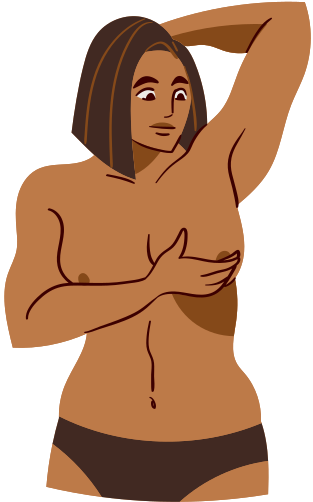
Breast self-awareness means becoming familiar with your usual appearance and feel, then speaking up when anything changes. You may notice changes while dressing, bathing, or putting on a bra.
The American Cancer Society does not recommend routine formal breast self-exams for women at average risk. Research has not shown a clear benefit to scheduled self-exams alongside screening. Awareness and appropriate mammograms both have a place in your care. Early breast cancer may have no symptoms.
Why the shift? In a large Shanghai trial, about 266,000 women were randomly assigned to intensive self-exam training or no training. After about a decade, the trained group had no fewer breast cancer deaths, but underwent more biopsies for benign lumps. A Cochrane review reached the same conclusion. That does not mean your hands do not matter. Many women still find their own breast cancers by noticing a change. It means the goal is familiarity, not a rigid monthly test.
A gentle starting point at home
- Notice your usual breast shape, skin, and nipple appearance. Pay attention to a new difference on either side.
- If you touch your breasts while bathing or dressing, notice a new lump, thickening, or change near the breast or underarm.
- If something seems different, write down when and where you noticed it. Bring the concern to your provider. These observations cannot determine whether a change is cancer.
Want to see how? Videos and guides from medical sources
If you learn best by watching, these come from medical organizations and physicians. Many describe a monthly routine. Use them to learn what to look and feel for, then choose a rhythm that keeps you familiar with your body. A study of popular YouTube breast self-exam videos found that most scored low on reliability, so stick with trusted medical sources like these.
- National Breast Cancer Foundation | Breast self-exam video and step-by-step guide
- GoodRx Health | How to do a breast self-exam, video with breast oncologist Brenda Panzera, MD
- Mayo Clinic Health System | Breast self-exams, with video
- Mayo Clinic | Breast self-exam for breast awareness, illustrated steps
- Cleveland Clinic | Breast self-exam, illustrated steps
Changes to bring to a provider
- A new lump or firm or thickened area in a breast or underarm.
- A new change in breast size or shape, or unusual swelling.
- Skin dimpling, puckering, or an orange-peel appearance.
- New nipple pulling inward, flattening, or a change in direction.
- Unexpected nipple discharge, especially bloody or clear discharge from one side.
- New redness or darkening, scaling, or a persistent rash on the breast or nipple.
- Breast pain that persists or a change that continues to concern you.
Most breast changes are not cancer. A healthcare professional can help determine the cause. Symptoms above draw on NCI and ACS guidance.
I found a change and need an appointment
Start with your primary care provider or OB-GYN. If you already have a breast specialist, contact that team. Describe the symptom when booking so the office can arrange the appropriate evaluation.
Words you can use
If you recently had screening, add: “My last mammogram was on ____. This change is new or is still present.”
Bring useful details
- When you noticed it and whether it has changed.
- Include the location and any nipple discharge, skin changes, swelling, or pain.
- Your last mammogram and any previous breast tests or biopsies.
- Medications, hormone therapy, pregnancy or breastfeeding status, and implant history.
Your clinician may recommend an examination, diagnostic mammogram, ultrasound, or other testing. A screening mammogram checks for cancer before symptoms; a diagnostic evaluation investigates a symptom or abnormal finding.
Before you leave, be sure to ask when you can expect the results, who will explain them, and what the next steps are if the change persists. If the results don’t arrive as expected, please contact the office; they’ll be happy to help.
When should I start mammograms
For women at average risk, U.S. organizations use different schedules. Discuss which plan fits you. Screening age rules do not mean you should wait to report a symptom.
| Guidance | Average risk screening schedule |
|---|---|
| USPSTF | Mammogram every 2 years from ages 40 through 74. For age 75 and older, evidence is insufficient; discuss individual circumstances. |
| American Cancer Society | Ages 40–44: option of annual mammograms. Ages 45–54: annual mammograms. Age 55 and older: every 2 years or continue annually, while in good health with a life expectancy of at least 10 years. |
If you have certain inherited mutations, a personal history of breast cancer, high-risk biopsy findings, or had chest radiation at a young age, an individualized screening plan may be right for you. Some people at higher risk may benefit from starting screening earlier and having MRI in addition to mammograms. Ask your healthcare provider for a risk assessment to help determine the plan that’s best for you.
A normal mammogram and a new concern
Report any new breast change, even after a normal mammogram. Your provider may recommend further evaluation based on the symptom. Keep following up until you understand the result and the plan.
What having dense breasts means
Density refers to the balance of glandular, connective, and fatty tissue visible on a mammogram. You cannot determine it by feeling your breasts. Dense tissue can make cancer harder to see on mammograms and is itself a breast cancer risk factor.
Read your mammogram letter. As of September 10, 2024, FDA requirements call for information about breast density. Ask your provider to explain your results and whether your overall risk means you may need additional imaging.
The USPSTF finds insufficient evidence to recommend for or against supplemental ultrasound or MRI solely for dense breasts after a negative mammogram. Decisions should take your full history into account. A symptom requires its own evaluation.
Questions for your next visit
- What is my breast density, and what does it mean for my screening?
- What is my personal breast cancer risk?
- Would additional imaging help me, and what are its benefits, drawbacks, and costs?
- When should I return, and whom should I call about a new change?
Family history worth passing down
Gather information from both biological parents’ sides, including relatives of all genders. Record the condition, the relative’s relationship to you, and the age at diagnosis, if known. Update the record as your family learns more.
Tell your provider about breast cancer at a young age, breast cancer in a male relative, ovarian cancer, multiple relatives with related cancers, and any known inherited cancer mutation. Ask whether genetic counseling would be helpful.
Use the family printable for other conditions as well, such as lupus, diabetes, or heart disease. Those entries support a broader health conversation and do not automatically indicate a higher breast cancer risk.
Ask permission before recording or sharing a relative’s details. Store the completed form securely and share it with those who need it. Mark uncertain information as unknown or unconfirmed. Adoption, estrangement, and unavailable records can create gaps. Bring those gaps to your provider without blaming yourself.
Frequently asked questions
Am I too young to notice breast changes?
You can discuss a breast concern with a provider at any age. Routine screening schedules and the evaluation of a new symptom serve different purposes.
Breast cancer remains the most common after age 50, but diagnoses in women under 50 have been rising by about 1.4% a year. Any new change deserves attention at any age.
How often should I do a breast self exam?
ACS does not recommend a scheduled formal self-exam for average-risk women. Become familiar with your breasts and report any changes. Ask your clinician whether your history warrants specific guidance.
How do I check my breasts at home?
Start with the appearance and feel you usually notice when dressing or bathing. Pay attention to any new changes and record them for your provider. An at-home check cannot diagnose a lump or confirm that you are cancer-free.
Can I get breast cancer without a family history?
Yes. Family history is a risk factor; its absence does not eliminate risk. Discuss age, breast density, prior breast findings, and other personal factors with your clinician.
Does a painful or movable lump mean it is harmless?
At home, a lump’s feel or tenderness cannot safely determine its cause. Benign conditions can cause lumps and discomfort. Ask a healthcare professional to evaluate a new lump.
Should I get a mammogram at 40?
USPSTF recommends starting at 40, with screening every 2 years through age 74, for average-risk women. ACS offers annual screening at 40–44 and recommends annual screening at 45–54. Agree on a plan with your provider.
My mammogram was normal but I feel a lump?
Contact your provider to describe the lump. A new symptom still needs evaluation even after normal screening.
Can menopause or hormone therapy change my breasts?
Hormonal changes can influence breast discomfort, and menopausal hormone therapy can affect breast density. Tell your provider about any new changes and all hormones you use. Do not assume a new lump is explained by menopause.
What if I have breast implants?
When booking imaging, tell the office. Ask separately about monitoring your implants and screening your breast tissue. Our implant resource will explore those questions in more detail.
What if I cannot afford a mammogram?
CDC’s National Breast and Cervical Cancer Early Detection Program helps eligible people get free or low-cost screening and diagnostic services. Use the program link in the resources section to find assistance near you.
Don’t quit in the quiet.
With love,
Jenn
Helpful resources and sources
Sources checked October 3, 2026. Guidance can change. Follow your healthcare team’s individual recommendations.
- American Cancer Society | Breast cancer screening and self-exam guidance
- National Cancer Institute | Breast cancer signs and symptoms
- National Cancer Institute | Breast cancer diagnosis
- USPSTF | Breast cancer screening recommendation
- National Cancer Institute | Dense breasts questions and answers
- FDA | Mammography Quality Standards Act and program
- CDC | Family health history and cancer
- CDC | People at increased risk for BRCA gene mutations
- CDC | Breast cancer risk factors
- American Cancer Society | Breast cancer signs and symptoms
- National Cancer Institute | Benign and precancerous breast conditions
- CDC | Free or low-cost breast and cervical cancer services
- TMZ | Brandi Glanville’s account of implant rupture
- American Cancer Society | Key statistics for breast cancer, 2026
- National Breast Cancer Foundation | 2026 breast cancer statistics (American Cancer Society data)
- Giaquinto and colleagues | Breast Cancer Statistics, 2024, CA: A Cancer Journal for Clinicians
- Thomas and colleagues | Randomized trial of breast self-examination in Shanghai, Journal of the National Cancer Institute, 2002
- Kösters and Gøtzsche | Regular self-examination or clinical examination for early detection of breast cancer, Cochrane review
- Quality assessment of YouTube videos as an information source for breast self-examination
Information and support
American Cancer Society: 1-800-227-2345, available 24/7 for cancer information and support.
National Cancer Institute: 1-800-4-CANCER (1-800-422-6237). Ask for cancer information or help understanding available resources.
The following two pages can be printed separately. Keep completed forms private.
My breast change and appointment notes
Know Your Normal | One page to bring to your provider.
This page records a concern. It cannot diagnose a condition or rule out cancer. Contact a provider about a new change, even after a normal mammogram. Do not wait for another at-home check to ask for care.
What I noticed
Mark any that apply, including lump or thickening; skin change; nipple change; discharge; swelling or shape change; pain; other. Circle or underline your observations.
My appointment
Questions and follow-through.
Keep this page and your results for reference. Bring ongoing concerns back to your provider.
My family health history
Private family record | Print extra copies as needed.
Record information from both biological parents’ sides. Ask relatives’ permission and note uncertainty. Include cancers and other conditions such as lupus, diabetes, heart disease, or mental health conditions. This form helps start a clinical conversation; it does not calculate risk.
Family information
| Relationship and family side | Condition and age at diagnosis | Known or unconfirmed |
|---|---|---|
Include parents, siblings, children, grandparents, aunts, uncles, and other relatives when relevant. Use relationships or initials if you prefer.
What I want my clinician or children to know
Update when you learn something new. Keep the original in a secure place and share it privately. Share unknown information with your provider.