Breaking the Myths of Midlife
Weight gain, hormones, perimenopause and GLP-1s, with hormone and metabolism coach Mandy White Eskelin
What are the biggest midlife myths about weight and hormones?
That you can gain five pounds of fat in one day, that lifting weights will make you bulky, and that “normal” labs mean you’re fine. Mandy explains why the old eat-less, do-more playbook stops working after 40, and why she starts with the foundation: knowing your hormone numbers, eating enough, and strength training.
Hey you, it’s me! 💋
Did you really gain five pounds at Thanksgiving dinner? Will lifting make you bulky? And if your doctor says your labs are “normal,” why don’t you feel normal?
Gobble gobble and wobble, besties! This week I sit down with perimenopause, hormone and metabolism coach Mandy White Eskelin, founder of Reignite HER, to bust six of the biggest myths about weight, hormones and midlife, plus a bonus seventh one for the men in our lives.
Mandy has been through two body transformations of her own, and then perimenopause “kicked her door down” in her mid-40s. Now 51, she’s sharing what changed when the old rules stopped working.
We Talk About
- 💋 Why you can’t gain five pounds of fat in one day, and the day-after reset
- 💋 The ’90s myth that keeps women afraid of lifting weights
- 💋 “Your labs are normal,” and the difference between normal and optimal
- 💋 Perimenopause vs. menopause vs. postmenopause
- 💋 Working out with chronic illness, and Mandy’s “health house”
- 💋 How food, coffee and skipping breakfast affect your hormones
- 💋 Why what works for your friend may not work for you
- 💋 Bonus: yes, men go through hormone changes too
- 💋 Mandy’s take on GLP-1s and peptides
This episode is for education and encouragement, not medical advice. Some of the products discussed may not be FDA-approved. Please talk with your healthcare provider about what’s right for your body.
Chapters
- 0:00 Breaking the myths of midlife
- 2:11 Meet Mandy: when perimenopause kicked the door down
- 4:24 The closet moment that changed everything
- 6:41 Myth 1: Did you really gain 5 pounds at Thanksgiving?
- 8:59 The day-after reset, and Myth 2: Lifting makes you bulky
- 11:19 Why women over 40 need to lift
- 13:35 Myth 3: “Your labs are normal”
- 15:55 Normal vs. optimal labs
- 18:05 Perimenopause vs. menopause vs. postmenopause
- 20:23 Myth 4: You can’t work out with chronic illness
- 22:51 Your health is a house
- 27:29 Myth 5: Food doesn’t affect your hormones
- 29:44 Myth 6: What works for her will work for me
- 31:57 Why intermittent fasting can backfire after 40
- 34:06 Bonus Myth 7: Men go through hormone changes too
- 38:46 Mandy’s take on GLP-1s and peptides
- 43:16 Where to find Mandy
Try This Week
Start with the foundation. Before you try another plan, ask for a full hormone and metabolic panel, including your thyroid, so you know your numbers. Then trade one 30-minute walk this week for a strength workout, and don’t skip breakfast before your coffee.
Connect With Mandy
- 💋 YouTube: @Mandywhiteeskelin
- 💋 Instagram: @mandy_white_eskelin
- 💋 Reignite HER: @reignite_her
- 💋 Her Midlife Fat Loss & Hormone Quiz and lab testing (code MANDY20): beacons.ai/mandyeskelin
Full Transcript
Read the full transcript
0:00 Breaking the myths of midlife
What if the reason you can't lose weight isn't you're doing too little? But maybe you're doing too much of the wrong thing. And what if exhaustion and brain fog, the weight that won't budge, isn't just stress. What if it's your hormones? You remember that myth? Eat less, do more? You're too young for menopause. We've been handed the same rules for 30 years. So many of us. Just feel stuck. Today, we're breaking all the myths of midlife. And some of these might be a little upsetting to find out they were myths all along. Welcome, y'all, to the Just Jelly Podcast. Are you looking for conversations that are raw and authentic? Then you're in the right place.
It's more than just a podcast, it's a community. Now, here's your host, Jenn. Hey you, it's me. Welcome back to another episode of Just Jelly Unfiltered. I'm your perfectly imperfect podcast host, Jenn. If this is your first time listening, I wanna just say welcome. And if you've been here for a minute, you already know I love you. And it is that time of year. It is the gobble gobble, and I am probably gonna be wobbling right after Thanksgiving. And I know we all feel that way. I like to check up and check in before we get started. How are you? Because today I am sitting down with Mandy to break all the midlife myths around hormones, menopause, eating, and our nutrition.
So help me welcome Mandy, our hormone and metabolism coach. We have the privilege of sitting down with her today, and I cannot wait to hear her story and break all the myths that we have been believing in the scripts we have been writing for years. How are you today? I'm amazing. I feel so honored to be here. Thanks so much, Jenn. Seriously, this is gonna be such a great conversation. We have so much to talk about, so many myths to bust. And I first want to start by saying: most people would never know that I've already had two weight loss transformations myself. And I had one after having kids where I lost 30 pounds and I did it in a very unhealthy way, not proud of it, but I did.
And then I went on to do my first fitness competition shortly after that. And I competed for about three years. But what I did to my body during that time, I completely destroyed my metabolism.
2:11 Meet Mandy: when perimenopause kicked the door down
My hormones, I had anxiety, depression, and I also had severe food intolerances and digestive issues, which that set me off to go to holistic nutrition school, become a certified holistic health coach and a certified gut health specialist so that I could first of all heal my body and then I could help other women do the same. And then, you know, I fixed my body and then something happened midlife. And I have to say I was not prepared for it. Most people say perimenopause comes knocking, it came kicking my door down. And I gained like 25 pounds in what seemed like overnight. And I know as a celebrity personal trainer how to work out. I know how to eat.
I know how to do all the things, but the rules changed. And when I realized how that happened for my body, that's when I set out on my journey to figure out the hormones, right? And then the peptide game and just all the things because I realized that things change. And we're trying to do things that worked for us in our 20s and 30s and no longer work. So that's why I'm like so passionate to be here because now at the age of 51, I'm healthier, happier. Girl, I would have not known you were fifty one. You just like myth number one, I would have never believed that sitting here with you in this interview. oh my goodness. But really, like in my mid forties, perimenopause and hormonal shifts happen.
And again, I know I knew what to do, but it wasn't working anymore. And so now with my age, I'm very proud of it. Not like but but I had to figure that out, right? And I had to embrace it. So now that I can help more women go through this midlife and redefine it for women. And we're gonna bust a bunch of myths today, so I'm excited. So at what age did you decide to start over the first time? You said you went through a weight loss transformation. Do you remember what happened, like after what year or how old you were when that happened? I was 32 when I had my son. And that was my second child via C-section. And it was after that that I had the 30 pounds to lose.
And I'm like, okay, I remember one day, this is a very vulnerable story, but I remember one day, I guess my son was about a year old, and I remember going into my closet and just trying on all the clothes and like the pants wouldn't even button up or some of them I had the muffin top or the tops were like crop tops on me now and my belly was hanging over. And I just remember trying on all my clothes. And most of us have those sections in our closet. We have this size and this size. And we're gonna save those for one day. Hopefully I can fit back in them. Right. And so I remember trying everything on and the only thing that fit me were like the yoga pants and the oversized sweatshirts.
And this pile began to
4:24 The closet moment that changed everything
accumulate as I tried it I'd throw it on the floor and I try it on and it didn't fit and I'd throw it the floor. And I remember at the end I was like hardly any clothes hanging in my closet other than sweats and sweaters. And I sat on that pile of clothes in my closet and I just sat there and cried. And I remember seeing my reflection in the mirror, my full-length mirror in my closet and I just cried and I'm like I didn't re recognize that person that was even looking back at me. And I felt like I had lost myself and I just made a decision that day and I gave myself permission and I bagged up all those clothes and And I went and dropped it off at a women's shelter.
And it was from that point on that I said, I am gonna do something for me. I'm gonna take care of my body and my health. And that was like I was about 33 years old. And that's when I lost that 30 pounds. And within two years, I was stepping on a stage for the very first time to do a fitness competition. Never had the ambition to do that before, but all of a sudden, somebody was like, Hey, you should do a fitness competition. I'm like, Cool, yeah, let's go. And I had no idea what I was getting myself into. But what I found, I discovered so much about me in that process. But that was like that first like transformation and really going, you know what?
I want to feel good in my body and in my skin again. And so that kind of was that very first one. And then it led into the fitness competitions for three years. Earned my WBFF fitness pro card, placed third in the world at the pro level that same year. Yeah. It was it was a lot in a very short period of time. I interviewed someone who was doing bodybuilding. She was a nutritionist and she told me some things like how you have to, I guess, super glue the butt together and Have the bikini just right. And I'm like, oh my goodness, the minute that you told me I would have to do that would be when I need to go to the bathroom. My and my nerves would tell me something completely different.
So I think that takes me to my first myth of when our hormones shift, we often look, especially since Thanksgiving, it's like right around the corner. We look at that Thanksgiving meal and we think, my gosh, I can't enjoy it. I can't eat it. And just looking at it, I'm gonna gain five pounds. I think it's really we fall into that trap. And your whole coaching, I read through your website is it's not eat less, more cardio. It's Balance. So how can we break that myth of is it are we actually gaining the five pounds by looking at Thanksgiving dinner? Well, let me just put in perspective about Thanksgiving, okay? Because what happens is most people, and I'm even gonna talk to women because I mean listen, we're ladies here, but most people in general, they will maybe skip breakfast that day and think, I'm gonna save it up for the big meal.
The calories, the calories, which is actually not what you wanna do, okay, because you save it up for the big calories.
6:41 Myth 1: Did you really gain 5 pounds at Thanksgiving?
But when you do that, now your blood sugar is all over the place, and then you're craving more of the bad things instead of maybe having a breakfast with higher protein in the morning and maybe a little bit of complex carb, like a little oatmeal with some protein in the morning. And then now your blood sugar is balanced. You're gonna crave less when you go into that dinner. But you don't you can't save up calories, ladies, okay? You can't. That is something that is just you don't do it. It doesn't work. So we're guilty of that. You cannot, okay? Nor can you go the next day and outwork what your fork. put in your mouth the day before. It doesn't work.
That's that is that old school, that's the playbook that might have worked for us when we were in our twenties or thirties. It does not, especially over the age of 40, it doesn't work anymore. Okay. It our our hormones change. We used to have the hormones that would support that when we were in our twenties. We could literally go fast and diet and run it off. It doesn't work anymore as we get older. And so I want to put also in perspective, you physically do not gain five pounds of fat in one day. you have to eat, okay? I'm I'm not I'm not kidding. It is really funny because most people don't get this that it would take you to gain five pounds of actual fat, you would have to eat an extra 17,000 calories, okay?
Wow. 17,000 calories to equate to five pounds of fat. Now, maybe on Thanksgiving because you're quote saving it up and you're eating more calories because those foods, let's let's be real. The calories, or I should say the foods are a lot more calorie dense. They're not very nutritious. I'm from the South, so we're talking all the casseroles. Like we have I have make like four casseroles. Sticks of butter that I put in my grandmother's recipe is ridiculous. Exactly. So they're more calorie dense foods that you're gonna eat that day, but they are not nutrition rich foods, right? Like nobody's going to say, Hey, I want to fill up on broccoli and salad on Thanksgiving Day.
They're wanting everything else. And so a lot of what we think that five pounds might be the next day is really just I'm not kidding with you. It's really just Sodium because the foods that you have that day are very high in sodium. So your body is retaining more water. You go into this food coma after, right? You're watching whether it's football or something, and you're not exactly getting up and going for a walk. You've been sitting in my living room. Well, yeah, it's the majority. I'm a fly on the wall, but really you're not doing a lot of active things after that. So most of it is really just water retention, and you probably haven't gone to number two to digest all of that food.
8:59 The day-after reset, and Myth 2: Lifting makes you bulky
But the next day it's great to make sure that you continue on eating your protein regularly, drink a lot of water, eat a lot of fibrous food so that your body and your digestion can clean some of that out is not actually five pounds of fat. Unless you consume seventeen thousand calories in addition to your normally caloric intake. A lot of calories. Exactly. That's so near impossible. Yeah. So it is in it is And I think that's the trap around the myth why this one is so important is because we wake up the next morning, we're in midlife, we're already frustrated because we over ate the day before. We see this five pounds we think is weight gain.
Correct. And we're like, okay, I've had a bad day. So why even I'll just wait till Monday. I can eat whatever I want. It's Friday, Saturday, Sunday. It's not gonna matter. I've already gained five pounds. When really, if we give ourselves that reset, that nice, like you said, eat higher protein the next day, hydrate, do go for a walk. Go for a walk. Go for a workout. This is also another trap that people think, I can go and burn off or run off my calories. Okay, you cannot do that. All right. It does not really work. You didn't gain five pounds of fat. Cardio burns some calories in that time period. But muscle is what burns fat. Okay. So the best thing to do the day after, which maybe you're one of those shoppers and you're going shopping, go fine, walk it off, but also go take 30 minutes and do a home weight of strength training workout.
If you can go to the gym, go to the gym. If not, then make sure that you do that because that will actually help your body burn more fat by lifting, not the cardio. Okay. So that brings me to myth number two is lifting weights is gonna make me bulky because most women believe that if they start working out in their 40s or their 50s, they're gonna bulk up and that's not what they want. And that's not really how it works either. So tell us a little bit about that and getting into weightlifting. Cause it took me a minute to break that old school mentality of just go to the gym. It's cardio. It's cardio. Just burn the calories. And it took me a minute going back to school to realize that muscle mass over fat is really what you want because the muscle is going to burn more calories naturally once you build it.
So yes. And muscle burns fat. I cannot say this enough. Muscle burns fat. Cardio does not burn fat. And especially if you're over 40, it doesn't work the same. So let's go over that whole be getting bulky. Like when I lost that 30 pounds, I got down to about 115 pounds to compete. I was 9% body fat. All I like back then, I'm saying to compete, I did a lot of fasted cardio. I lifted a lot of weights. I was in the gym two, three times. It was not healthy. It's not sustainable. It's not healthy. But I actually tried for years really, really hard to lift weights and actually put on a little bit more muscle.
11:19 Why women over 40 need to lift
So that when I stand on stage next to these girls who have been weight training for 10 years, that I had as much muscle, it's almost impossible. Okay. It can take a woman, it can take a a woman about 90 days even to put on one pound of muscle. Wow. Yeah, it's not as easy as we think. We don't have enough testosterone in order to get bulky. I'm 51 years old and I lift weights three, four times a week. That's it. But I'm not bulky by any means. And I can't get like it's almost impossible to get bulky. So the peop the ladies or the when you see somebody that is very bulky, let me just say they are taking some sort of enhancement to be able to gain that kind of muscle.
We do not naturally have that. And and I want to add another thing that's so important that most women do not realize. After the age of 40, we lose three to ten percent of our muscle mass every 10 years. Think about that for a second. Three to 10% every 10 years. So after the age of 40, you're losing 3 to 10% naturally. After the age of 50, you're losing 3 to 10%. Now, once you're post-menopausal, meaning you no longer have a period and you're past menopause, we lose more muscle mass faster. So it is imperative, and I say that, it's crucial for us over 40 to lift weights because we need it in order just to keep it, right? We need to lift in order to just keep what we have.
It's almost impossible to actually build a lot more muscle, but we need it to keep it. And muscle, by the way, most women don't know this. When you actually lift, right? Like I'm doing a bicep curl right now, when you actually contract that muscle, the muscle and the tendons and the ligaments, they pull on your bones and force your bones to become stronger. Cardio cannot help you with that. Yeah. So resistance training for women, because we, as our hormones start to shift, we lose that bone density too. We need estrogen for our bone density, which depends. Starts starts declining after the age of 40. And now if you don't lift, you are increasing your chances of osteoporosis.
So we need to lift, ladies, just to keep the muscle we have and just to help protect our bones and our bone death. So it is, it's impossible to get bulky unless you're taking something like on black market. Okay. Let's be real here. Like black market stuff. Even I'm on hormone replacement therapy now, which we can talk about later, but
13:35 Myth 3: “Your labs are normal”
Even on the tiniest, lowest microdose of testosterone that I'm on, I have not gotten any bulkier ca and I still lift weights three, four days a week. So you would have to get on literally some kind of black market stuff in order to get bulky. So I think that would bring me to myth number three that it does not show up and affect our hormones or our weight loss. Because often you'll go to the doctor, you'll be in perimenopause, and our blood work will come back as normal because the myth is, you're just getting older. It's part of human nature. Your body's gonna change. But there are things that we can do in order to Recognize those symptoms and start regrouping as soon as perimenopause hits.
So I do have a question. Do you remember when you hit perimenopause? Because a lot of people don't know that it can happen as early as 35 years old. It can happen as early as 35. I remember not knowing it was perimenopause because remember when I was competing, I messed up my hormones. I didn't even have a period for a year because I got my body fat so low that I really messed up my hormones. So mine were just trying to get things back to a normal range after competing, after I retired in 2014. After that, Then things, I mean, I remember the moodiness after that. I remember, but the biggest piece was the night sweats. I would wake up in the middle of the night and I could feel just all in my chest area.
I was like, yuck, this feels gross. But I would wake up in the middle of night, night sweats. I was very moody. I was tired all the time. Those were like the beginning symptoms. But then it was about 45 years old, 46 years old, that I was still doing the same. cardio based workouts. I'm gonna be honest. I was still dieting. And then all of a sudden my body started to put on weight from me doing the same things. And I couldn't figure it out. And I started crying a lot. And I'm like, what is going on with my body? I didn't recognize it again, but I was doing quote everything right. And so that's when I started going into the whole, let me go get my hormones checked.
And I, like many women from my OB-GYN, heard your labs are normal. So let me cover what that exactly means. So When you get your labs done, and if your doctor has told you your labs are normal, you need to find a functional medicine physician, and I will explain why. So the your OB-GYN or even your primary care physician, they are looking at your labs in a clinical range. Okay. This clinical range takes an average of people our age, including sick people. Okay. And then that's lumped into this quote normal range. If you were normal, and if things were really normal, let me just say,
15:55 Normal vs. optimal labs
You wouldn't feel the way that you feel. Okay. So there's in the functional medicine world, which right now I'm working on my functional medicine practitioner certification. Yes, another certification, but why? Because in functional medicine, they can look at things in an optimal range. Okay. So there's normal, which great, you're a normal send you on your way. You have no idea how many times I heard that from my own OB-GYN, even last year. But that set me again to find a functional medicine physician to partner with that understands it from an optimization standpoint. When we think about our metabolism and our hormones, they were the most balanced and optimized when we were about 25 to 30 years old, if you really think about it.
Our sex drive, our sleep, our energy, our mood, like our metabolism, like everything functioned so amazing when we were about that age. Functional medicine does is looks at it as how do we get you to this optimal range, not that clinical medical range that includes sick people. How do we get your levels optimized? Does that make sense? Yes. 'Cause I've actually worked with one before because I was getting those same answers of you're normal. I'm like, because I had a full hysterectomy at 31. So I was put into surgical menopause at 31 and no one wanted to help me. Nobody really understood what I was dealing with. I was getting migraines. Like every woman is different and can have a whole laundry list of symptoms.
And I was going in and I was hearing, no, you're normal. And so I just actually something I will touch on briefly, just went back to the doctor and you were talking about muscle. That's why I was so excited to have you on because when I started working out, that's what I was hearing from my friends and some of the ladies that I coach of, you're gonna become bulky. And I'm like, No, that's not how it works. Because I went to the doctor and my doctor told me your bone density test is one of a much older woman because they had had me on it wasn't the proper estrogen for all these years. I would had been on synthetic instead of what I needed to be on.
And my bone density was Taking a huge hit. And so it was already causing me to not be able to work out at the capacity that I wanted to. And so I really had to kind start at zero when I started. So that's why I was like, my gosh, I'm so excited to have her on because women do believe that myth of, if I work out, I'm gonna get bulky, or I especially the I need to do more cardio, eat less. That's that's all those things we heard in the 90s. 100%. Listen, I I grew up in the 80s and obviously in the 90s, but
18:05 Perimenopause vs. menopause vs. postmenopause
That was I remember the 80s was like the Jane Fonda fat-free era, right? And with my mom. Like that's what I watched my mom do. And then I watched, you know, my mom go through surgical menopause in her in early 30s as well. I watched my grandmother where, you know, this is just like a you're told, this is just part of aging or this is what it's this is what it's supposed to be like. And I'm telling you that I'm like, hell no. Okay, sisters, hell no. We are here to redefine midlife. And that is What our moms or our, you know, grandparents or grandmothers went through, but that does not mean that that's what we have to do and just settle. You do not have to suffer through this because there's a difference in perimenopause and postmenopause and menopause.
Let me break that down. Yes, perimenopause can start as early as your mid to late 30s and it can last up to 10 years. That is that is crazy, right? Now, menopause, it is just a date on your calendar. Most people they they don't understand this. So menopause is just a date on your calendar when you have hit. 12 months with no period, bam, there's your marker. That's menopause, you've hit menopause and now you are postmenopausal. So anything prior to that date on the calendar, you're not in menopause, you're in perimenopause. And that is when your hormones, some check out, some go on their own roller coaster journey and it's all happening at the same time.
That is when nothing works the way that it used to, even though you're trying everything. But that is all perimenopause. And then once you no longer have a period for a year, you're now postmenopausal. So there's a whole set of things that we have to cover and watch out for and replace when you're postmenopausal. But I will tell you, ladies, it is so important to get those things in check and balance in perimenopause. Don't wait until you no longer have a period to go see about bioidentical hormone replacement therapy or to go get your labs done. If your doctor, I get so passionate about this, if the doctor tells you I had the fork. Let me tell you, because we were talking about food, so I had the fork.
But if a doctor tells you you do not need to check your labs until you no longer have a period Go find someone else. I will send you to my person. That is insane. You do not have to suffer through those years of perimenopause because there's things that you can do to balance your hormones in perimenopause and not wait until you no longer have any hormones whatsoever. There's a difference. So menopause is just that date on the calendar. Prior to that, it's all perimenopause, sisters. So we can do something about it. And here's the thing: in perimenopause,
20:23 Myth 4: You can’t work out with chronic illness
The rule book changes. The playbooks that you've been going by doesn't work anymore. So they requires a different playbook in this time frame. And then a different one, postmenopausal, especially if you're not on any type of hormone replacement therapy, which we need. So I just wanted to clarify the difference in those because most women say, I'm in menopause. Actually, you're either perimenopause or postmenopause, one of the two. And they just updated a lot of the regulations around studies and expectations and what that normal range is going to be. I just, I've been doing a whole lot of research on all the new releases this month in October in.
Thank goodness they're starting to do more research for us ladies. They were not on the ball, so they dropped it, and we have just been left to pick up the pieces because I felt like I don't know how perimenopause felt for you, but for me, I was in surgical menopause and I still feel like I woke up around probably around my 40s. And I my life just no longer felt like it fit. I was done like it just felt like I was a different person one day. And I couldn't understand why I was feeling sad and miserable and didn't really want to be around people. I was starting to isolate, even though I'm an extrovert and I'm like, I have a podcast. I am. Out in public.
I can't just start staying at home 24/7. So I think a lot of people fall into that trap. And I think one thing I would like for you to talk about is all the different options that the ladies do have. Because I know that for me, I would have not searched in the Google bar Perimenopause coach or or a metabolism coach or for me, I'm a certified wellness practitioner. I wouldn't have known to search that in Google. So there's so many options out there. So for me, I worked with a nutritionist and a holistic doctor. Because this brings me, this will kind of go into our myth number four of you can't work out with chronic illnesses. I was told that from the moment I was told I had lupus.
They were like, you'll never work out again. You don't need to be lifting weights. It's gonna affect your fibromyalgia, which is also false. It's the biggest myth I was ever told when I was in my 30s of I can't work out with chronic illnesses. Honestly, it's almost like nobody wants to get up and go to the gym. It's something that you grow to love. Your body's the same way. You start out small and you work your way up and eventually the body will adapt. Yes. And finding those doctors that will help you get to that next step. So you can adapt. So you can grow. So you can build muscle. So when you are on the post menopause side of things, you're not just stuck there.
I went through this phase of skinny fat of where I wasn't working out. I was just strictly doing the cardio and I still felt like my body was just flabby and gross. It didn't matter how skinny I was. So let's dig into that just a little bit. What doctors would you tell someone listening or help to reach out to first? For chronic illness, you're talking?
22:51 Your health is a house
Maybe chronic illness, menopause, because I know when you go to your standard OB, they're gonna go by the standards. And I think a lot of people aren't aware of the other options that are out there, your nutritionists or your practitioners or your holistic doctors, those kind of things. Yeah, that's the thing with your traditional primary care physician, your OB-GYN, they're going by these these the A big pharma clinical range boxes. And I'm sorry, ladies, but none of us deserve to be put in a box, okay? None no one. My recommendation, honestly. Is find a functional medicine because like I partnered with one. I'm working on my functional medicine practitioner, functional medicine practitioner certification because I get the functional medicine part and I do workouts.
I do the nutrition and I'm talking from my client. I do like peptides. We work on hormones, but I want to talk about this because it's important to know why and where to start. Your health is like a house. You're not the size of a house, ladies. You're building a house, okay? So the foundation of your house, the foundation, would you not say the house that you're in and I'm in right now, the foundation of these houses, the most important part of it is the foundation, right? It is. The foundation of our of our health house, us, is your hormones. And then nutrition is the rebar that goes in there to make it stronger. So the foundation of your house, your house is is hormones.
And most women don't either they're told it's it's normal or a normal range, or you don't need to check it right now. Please hear this. You want to know what those numbers are. If your doctor will not run a full hormone and metabolic panel, including your thyroid, find someone else. Reach out to me. I will send you, connect you with mine because it's so important to know where those numbers are. So then you know what to do next. And weaved in there is your nutrition as part of that foundation. It's the rebar of the foundation, which really, if you think about it, you need rebar in there to really lock everything in. That is for your your protein, your fats, your carbs, all of your micronutrients is vitamins, minerals, enzymes, antioxidants.
You need all that. That's all part of your foundation. Now, next. The walls, that's the two by fours. That's your bones and your muscles. That's what holds up the rest of the house is that bones and muscles. This is where strength training is crucial. Strength training comes in. Then the roof. Okay. Now you gotta have all of that in place. And then the roof is targeted support like supplements and peptides. Okay. This is where, and you're probably going, you a little smart because you know where I'm going with this. Most women ignore the foundation, which is hormones and nutrition. They're not strength training and they go right to the roof. You cannot put a roof on a house.
You can't. If it has shoddy foundation, paper thin walls, what happens when you go to put that roof on there? It completely crumbles. But most women go to let me try this supplement and this supplement and this GLP and this. And they've never fixed anything in the foundation. Nothing. And that's so important for women to understand that we've got to fix the foundation. So where to start first? Go and find a doctor. Even if you have to do cash pay, like whatever you got to do, get your labs done. And I'll even share, even me being on. Bioidentical hormone replacement therapy, I still get my hormones checked, all of my labs done every six months.
You wouldn't even believe that I have some things going on with my thyroid, as healthy as I am. But if I would have, by the way, my OB-GYN, she just ran the regular panel and didn't cover my thyroid, and luckily my functional medicine did, and we found because there's more than just one part. Most people think it's your TSH, but you have your TSH, your T4, and your T3 when it comes to your thyroid. Most doctors don't even run T3 or T4, just that TSH. Well, guess what? For me, my TSH was in optimal range. My T4 was in optimal range, but my T3 was very low and it was even below clinical range. This has to do with your conversion. But if you don't see someone in a functional medicine to be able to pull all of those labs, everything below there, like most doctors don't even pull or know anything about sex hormone binding globulin.
That has to do with how your body deals with or or uses, utilizes testosterone. in in your body or whether you're taking bioidentical. So that's an important marker underneath all of that to know. But most people have no clue about that. So if you're asking like where to start, I wouldn't say a nutritionist. I'm a holistic nutrition coach. I wouldn't say you're nutrition. I would say get those labs done so you know where your numbers are because if you're in perimenopause, you can do something about it now and balance things. If you're postmenopausal, you really need to do something about those numbers. Again, that's the foundation. Because when I coach my clients, that's the first thing we do is we Do those run those labs so we know where are the cracks in the foundation?
What do we need to fix? And then we get those things handled. And then I dial in their nutrition and getting them eating more. And actually it's called a midlife refeed. And it is getting them eating more. Because have you ever heard of metabolic adaptation? Mm-hmm. Okay. So I'll explain it to the listeners because most women don't know what this is. Most of them, yeah. Okay. So what happens is we think we need to eat less, right? We're told we need to eat less, do more cardio.
27:29 Myth 5: Food doesn’t affect your hormones
My my nutrition program, by the way, is called Eat More Burn More. So just like the complete opposite of all of those stories. But what happens is when we go down and cut down to 1200 calories a day, what happens is here's our caloric intake and here's our metabolism. When we drop that down, our metabolism isn't running fast anymore. Our metabolism says, I don't have enough energy to keep up anymore. So I need to slow down to meet the level of input. That is called metabolic adaptation. And most women think they just have to keep eating less and eating less and eating less. And what they're doing is they're destroying their metabolism as well as throwing off their hormones.
So what I do is it's a midlife refeed, and we slowly start to not just calories, but we increase protein, healthy fats, healthy carbohydrates. And now the metabolism's like, cool, I need to speed back up again. And this is how we rebuild the metabolism, even in 40s, 50s, and 60s. So that is a really important part. But You asked where to start. You gotta you gotta know where to start, which is at your foundation. I completely understand. I think that brings me to myth number five that most people don't realize our nutrition impacts our hormones. Everything we eat and drink impacts. Everything we put on our body can even impact our hormones. Not enough people actually realize that.
So that's myth number five is my nutrition does not impact my hormones. What do you think about that? How are we gonna bust that one? False, false, false, false, false. Okay. So let's talk. One of the things we haven't talked about is cortisol. So What most women do, and I probably would say nine out of 10 of my clients, when they first come to me, are doing this. They're like, I it's in the morning, I'm going straight to coffee, I need to wake up, and they skip breakfast. Now there's a couple of things that happen here. Number one, your blood sugar drops because you're not giving it fuel. Just like your car needs gas or electricity to go down the road, your body needs fuel as well.
And so what happens is now your blood sugar drops. The coffee raises your cortisol. And your cortisol is your fat. Producing and fat storing hormone. Okay. Fat producing and fat storing hormone. So when you skip breakfast and you just go right to coffee, you are dropping your blood sugar. Your body is raising cortisol. It's stressed. gosh, she didn't feed me. gosh. And it causes like this internal stress and anxiety for the day. Now the first thing you eat, your body is storing that as fat. And so now your hormones are like, okay, I don't know what to do. But by eating, just by eating a balanced breakfast with protein, healthy carbohydrates, and maybe just a tiny bit of healthy fats.
29:44 Myth 6: What works for her will work for me
gets your blood sugar balanced in the morning and it balances your hormones and your cortisol throughout the entire day. And also by eating every three to four hours that way, you have no more cravings. Your body is like, okay, she's feeding me. I don't need to store anything extra as fat. I'm not craving anything. I'm happy. And that also supports your hormones because we need Protein for our muscles. We need healthy fats for our testosterone and hormone production, as well as for our brain. We need carbohydrates. We should not be afraid of carbohydrates. It has to do with what you're eating and when you're eating and what you're eating them with.
But we we need carbohydrates for energy production as well as for our hormones. So this is where the midlife refeed really comes in to teach women how to eat more, to burn more, and it's not eat more, store more. It's literally to help regulate and balance all of those hormones, including your cortisol. So that your body becomes a fat burning machine and not a fat storing machine. Right. That's exactly it. Is we don't wanna be storing the fat ladies. We want to be burning it off and using it throughout the day. So I think that brings me to myth number six is I think women in general think, it worked for her, it's gonna work for me. Each body is different.
So even though something may work for me, it might not work for you. So we're gonna break that myth of one size fits all, because I don't think there's one packaged plan out there that's gonna work for any for A group of people. It might work for a few, but it might not work for you. We get frustrated. We do go to our doctor. They're telling us everything's normal. Our friend is losing weight because, well, she's weightlifting and going to the gym and I try to start that. And then I my body's not performing the same as hers. And then I'm in that trap of now what do I do? Where do I go now? What's next? That is where you the the reason that it's not working, like you just said, it's working for her and not for someone else, or working for my friend and not for me.
That has to do with the hormone function because your hormones regulate The fat loss, your muscle, all of those things. Like when I was a personal trainer in the gym, celebrity personal trainer, all I knew was just eat these macros and and and work out, right? Like that's what I knew. That's what I coached my client. But then there were women that were my clients that no matter I watched what they ate, I obviously trained them, but they weren't losing the weight. And this is where the difference comes in because of the hormone function underneath. This is that foundation. And so
31:57 Why intermittent fasting can backfire after 40
I will be honest and say I am not a fan of intermittent fasting over 40. It doesn't work because it causes our cortisol to raise. We eat away, our body eats away muscle, we become skinny fat. So it we have to feed our body, but we also have to have the hormone function that supports it. And that's where you create that rock solid foundation and your body will become a fat burning machine. That's why most women don't realize it's not just the eating or just the working out. That hormone function plays a massive, massive part underneath that. And it dictates how our body is going to respond to everything. I think the biggest objective with my clients that I try to start with when I'm coaching them is finding a lifestyle that works for you.
You mentioned intermittent fasting. I did that for a hot minute back in my 30s. Worked great. I loved it because then I'd break and I thought I was doing something good. I could eat my whole 1400 calories in three or four hours. I was just doing whatever I wanted. But then life hits. You're going to be traveling. You are going. to have kids and family and they're not gonna want to eat at 3 p.m. in the afternoon just because you've been fasting all day and you want to eat if you don't take anything else away from this episode, ladies, is start with the foundation, get your hormones checked, know what numbers you're starting with, know that everything you put on and in your body is affecting those hormones.
And it can start as early as your mid thirties. I was not aware of that. And my a friend of mine, when I was in my thirties, I like, there's no way. Hey, like I've had a full hysterectomy and I would know the symptoms. You're not in perimenopause yet. And she was like 37 and the doctors were telling her she was completely normal. So and it's okay to get a second opinion, too ladies. Mm-hmm. Yeah. So the other thing, I didn't have this as a myth, but I'm gonna put it as myth number seven, is that men do not have hormonal shifts and do not go through their own form of menopause. Because they do. And I love that you're so excited about it. So tell me all about it.
man. I'm so glad my husband just left the house too, so I can really talk. Yes, they do. And I like to call it manopause, right? Manopause, but they do. Ladies, it is I watched my cousin go through it, okay? So this is I know this for a fact. And my husband's five years younger than me. He's 46. I'm 51. But I watched him right around the age of 40 go through a change. Now my husband is a bodybuilder. I'm not a bodybuilder, but he is a bodybuilder. Big muscles, all of that. And
34:06 Bonus Myth 7: Men go through hormone changes too
The way that I saw his mood change, his sleep pattern, his eat pattern, his libido go down, his moodiness. Like sometimes I'll be like, my gosh, my husband's on he's PMSing. Like I recognized it, but I've watched it for years and he is on testosterone replacement therapy. You know, he's on some things to help his own production as well. But I yes, men go through it. So a lot of times, and I'm not saying that this is normal, but men start to gain weight around their midsection, like we do, ladies, going in perimenopause. And menopause time frame, but men get that that belly, and then they also get these like quote man boobs start forming. That is all part of hormonal shifts for men.
You can watch them, just observe it. If they're moody at times, they're really, really tired, they come home from work and just want to crash, like, you know, they're chasing caffeine all the time, their libido might be lower. Those are all signs of menopause. And it is a real thing. And your man might be like too prideful, too ego to go to the doctor, but there are male specific hormone replacement. therapy, you know, practitioners, whatever. But it's more common for men to get on testosterone. Now they have a lot more testosterone in their body, hence why they can get bulkier than we can. But when that drops, a lot of times what happens, their estrogen will start elevating.
And that's where the moodiness, the, the low libido, the belly fat, the man boobs, all of that happens for men. So it's a real thing and they don't know if we don't go and advocate for them, but they might not want to hear it from us exactly. They might not want to hear like, honey, you need to go get your hormones checked. So we gotta be a little bit more careful with how we brings bring that up. But yes, it is a real thing. It is. And you know what? It it was really hard to watch my husband go through that. Now he did try different things, but now he's got it it's perfect now and dialed. But think they're a little more prideful than women are.
They weren't raised in that era where they were told their dad wasn't sitting them down going, Okay, son, when you hit your forties, you're gonna be hormonal. And I was laughing because I did an interview last season and we talked about this a little bit. Like women, if you're seeing your man just staring at the fridge like it's holding the answer to life, he's probably going through it because they question and they want to start over. They question everything that they every choice they've made. That's why it's called a midlife crisis, just like us. And I think that's why gray divorce is on a rise, is because we don't talk about these sensitive topics enough.
We don't bring it to the table of men are going through it just in a different format as a woman, but we all have hormones. I just read an article, men have boobs too. They can get breast cancer. Like yeah, our bodies do function in a lot of similar ways, even though we're completely different. So I wanted to bring that up that because I thought that was hilarious. Next month, no well, this airs in November. So this is men's month awareness. Why men and so I'm really focusing. I have a whole episode dedicated to why men do not talk about their health and go get help and want to talk about their signs and symptoms of menopause and that kind thing.
So Yeah, it's so true. They are so prideful. Their ego won't let them admit that. It took a lot. It actually took a lot of arguing to get my husband to actually go. But once he realized how much better he felt, it's an open conversation. And he used to be a personal trainer as well and performance coach. So he's talked to a lot more men, helping them understand that now that he's gone through it. I mean he's 46 now, but he it was like right at the age of like 39, 40 is when it hit him. And I saw that. It was, it was almost like a midlife crisis. He's second guessing everything. And I'm like, what happened to my who Who stole my husband? Like, did an alien come and abduct him or something?
Like they go through it and it's hard for them to identify and even verbalize and communicate what's going on because they don't know. They're not familiar with it. We're used to the hormone fluctuations everywhere, right? F since we were what, 13? But they're not. And so it's really harder for them to to talk about it, to say, hey, I think I need to go get this checked. But advocate for them, please, ladies, because it is a real thing and they deserve to feel in midlife. Just as optimized, right? And I say optimized because a guy at like twenty, that's when his was most optimal. Let get his numbers back there and watch what happens to you're gonna see him come back to life.
And if you both get your numbers in place, you both will come to life and the happier the life will be. So there you go. Right. It's not just how I appreciate you so much. This has been so much fun. If you had anything else you wanted to tell our listeners before we leave, what is one thing that you would want them to take away? Definitely say find a functional medicine physician that will do all of your labs. Just know the numbers, ladies, because that is going to tell you so much where to start. I know so many women go right to the GLP-1s, but if you think about the health house, you're putting a roof on when you haven't even fixed the foundation.
It makes such a massive difference. And if you want to get on GLP-1s, absolutely, most of my clients are, but we do it once we fix everything else. We fix everything, we have their nutrition dialed in, we've got them strength training. And now the tiny bit of GLPs.
38:46 Mandy’s take on GLP-1s and peptides
or peptides for other things will enhance the results. And I'm just gonna say when you know those numbers, it's a game changer. And don't let somebody tell you that you're in normal range. Get a second opinion because normal, if you, if if it was normal, you wouldn't feel or have the symptoms the way that you do. And your body better than anybody. So don't let a lot of I know a lot of my clients come to me and think, is it all in my head? I'm like, no, I promise you, if you're feeling it, your body better than anyone else. So I have to ask you because not a lot of people talk about this either. What is your favorite peptide? What's your go-to?
What do you use? Because I use Samaxin. That's my favorite peptide. I would let me think for a second. Gotcha. you got me on that one. Hold on. I don't think enough people talk about peptides because they both have they have their pros and cons. Like I just don't think enough people talk about it and know that it can it can be a great tool in your toolbox to come alongside and help with your fitness goals. So what are your two favorite? My two favorites, I would say, is retatrutide and CJC-1295/Ipamorelin blend. Those are my favorites. That's the ones for and and I'd probably say the third one would be MOTS-c, but that is like a stack that I do with my clients once we have the foundation and the walls built and then we come in with those.
That enhances everything. And there's so many health benefits. And most people think that peptides are all GLPs. They're not. There's so many other ones that are not that can help with lean muscle, inflammation, recovery, collagen production, all of those things. I mean, listen, like I A refrigerator in my bathroom that has all of our peptides. Same girl. Same. Yeah. Okay, so tell our audience that's listening what those three peptides do, because they may not know. So retatrutide is GLP-3. And why that one's different, it is not semaglutide that just suppresses your appetite and then you can't eat and shuts down your digestion. It's not like tirzepatide where it has GLP-1 and GIP.
It is the third generation. It's actually getting ready to come out, sadly, as a pharmaceutical drug. And by the way, a peptide. Cannot be a pharmaceutical drug unless they actually change the molecular structure. This is really, really science geeky. But why I love retatrutide is because it is has three agonists. Okay. It has a little bit of GLP-1, a little bit of GIP, but the last one that makes it so special is that it works with your glucagon receptors. Now I'm gonna get really geeky. Your liver releases glucose into your bloodstream. Okay. So this is where my clients are eating carbs and they're getting even better results because with retatrutide, you need the carbs.
The right carbs because when your liver releases glucose, now the third agonist helps and goes in there with a glucagon agonist, and you've got the GLPs and all that working together. So it actually regenerates and detoxifies your liver. So many health benefits with that one. It also helps with your brain health. There's there's more studies coming out on that, and it helps you keep muscle and burn fat instead of just becoming that skinny fat where your body is just not eating, and so you lose all that muscle. which we need to keep and bone density, which we need to keep. So I love retatrutide for that reason because it works with the glucagon receptors and GLP-1 and GIP and just that combination, it is so extremely powerful when done with the right nutrition.
It has to be done that way. The other one, CJC-1295/Ipamorelin, this one is one that helps with sleep. It helps with lean muscle. It helps with fat loss. What it does is it goes, you take it before bed, but it goes and knocks on your pituitary at night while you're sleeping and tells your pituitary to produce its own growth hormones. We need growth hormones. I don't, I'm not a fan of the exogenous synthetic ones. Peptides like this will actually help your body go and produce them again. And so that's what we want is our body producing, our body doing the things that they used to do. And so that's where CJC-1295/Ipamorelin comes in. And then the third is MOTS-c.
MOTS-c helps with some insulin, insulin resistance, especially for women in menopause phases, but it also helps with mitochondrial energy because our mitochondria need more energy And that one helps with energy production. And so that's probably my favorite three, but then I could say KLOW as well. I could keep going, but those it's hard. You said glow, right? KLOW. Okay. So I haven't heard of that I've heard the glow recipe that's supposed to help like collagen and so clow is four peptides in one. The BPC-157 for gut repair as well as recovery, TB-500, which also helps with connective tissue and our body recovering. Then it has the GHK-Cu, which is the copper peptide, which helps with skin and collagen production.
And then it also has KPV, which helps with anti-aging. It also is anti-inflammatory. And so I really like that blend a lot for recovery, for anti-aging, for gut repair, and just for overall collagen skin and joints and everything. Okay, so tell everybody where they can find you because you're just amazing. And if you guys aren't watching, you need to go over to YouTube and watch. She is amazing. She's beautiful. She's got muscle for days. I think I need to join your gym. You're so funny.
43:16 Where to find Mandy
I actually retired from the gym. I let's see, almost 10 years ago. I do everything online. That's what I love doing because now I can really help women all over the United States and Canada. And so they can find me, Mandy White Eskelin, on Instagram or on Facebook. You can message me. I can always give you a discount code if you want to go and get your labs done with my functional functional medicine physician. And I just love being able to help women, honestly, because I encompass everything into my program. The hormones, the nutrition, the workouts, and then the peptides and supplements. So we cover everything comprehensively and I am so hands on and one on one, but I love helping women.
I love educating. I love helping women. I love having these conversations. So, Jenn, thank you so much for having me today. It has been a It's been a pleasure. I've learned so much, even just from the interview myself. I just now recently got back into wellness and menopause and studying. I've been in school the past two years. So I'm working on it. I'm getting there. It's so many things to learn. I mean, it's a lot of information. But I love having you on and I loved your plan. Tell them a little bit about your nutritionist plan because I did see that online. Eat more, less cardio. I was all about it. Yes. Eat more, burn more is actually what my nutrition program is called.
But that's all tied into this because I help women refeed in midlife. I help them learn how and what to eat to refeed your body so your body becomes a fat burning machine. And then we add, you know, the hormones if needed. We add the strength training. No cardio. My clients get incredible. transformations and there is zero cardio. I will literally tell them if you've got 30 minutes to walk, you take those 30 minutes and you go lift weights instead. Every I yes, I'm a I'm all about strength training because again, we need it for our bones and our muscles and that is gonna burn more fat. And then we bring in the peptides, you know, to enhance the whole package at the end.
And so I just love like refeeding. Ladies, we want to eat food. Who wants to sit there and starve themselves leading up to Thanksgiving and then go pig out and then feel like, well I just blew it. I might as well keep eating like this for the next couple of days and then just start on Monday kind of thing. No, like one bad day turns into one bad week, one bad month, and then you're nice and you're back in a new year going, it's gonna be a new year, new me, and it never happens. It never happens. I watch women do this all the time. I really do. And it's sad because it doesn't have to be like some women are like, Hey, I don't want to start a program right now before the holidays.
I'm like, what would it feel like to walk into the holiday parties losing 10 pounds, eating what you want, feeling more confident, feeling less stressed, more in control, and now you start the new year, you it's not a diet. I'm actually gonna tell you to Eat more. And I will tell you, that's the one complaint that my clients have. Mandy, this is too much food to eat. I'm like, good, just shut up and keep eating. I literally say this, just keep eating it, girl. Just keep eating. And then that they're like, Really? I can have all this. I'm gonna get fat. I'm like, no, you're not. Watch what happens. And I have clients that go from eating one meal a day.
And this was what Melissa's one from last year. She was eating one meal a day. She was intermittent fasting and she was eating one meal, but then she was snacking at night. And as soon as I got her eating breakfast within the first hour and eating small meals every three to four hours. She lost 15 pounds in her first month. 15 pounds of fat by eating more food and we didn't even touch peptides. It was literally just refeeding her body and getting her metabolism rebuilt. We we rebuilt the engine like a car engine. And once we did, now her body is running on fuel that it needs and not storing everything as fat. And I got the pictures to prove it.
So it's I love that. oh my goodness, I love it. Well, thank you so much for sitting down and thank you guys for hanging out with us this today at the table. I've I think this has been a 10 out of 10 conversation. I can't wait to have you on again. I love it. And you guys, I will tag her down below as well in this episode. So you can go look her up, check out all her information. Thank you again for being on. I loved this conversation with Mandy today so much. If you loved her too, go over, learn more about Reignite HER. You can find her on Instagram at @mandy_white_eskelin. I will also be tagging her down below. Now we want to hear from you which myth.
Have you believed the longest? Write me back over in The Sweet Spot and tell me because I read every note. If you enjoyed this episode, please share it with a friend. Don't keep our little community a secret and sign up for The Sunday Scoop because there is a lot going on at Just Jelly Podcast. Next week I'm talking about becoming an empty nester, the hardest door I've ever had to open. My daughter's empty room. I'm learning to parent adult children. And the night she came home at 3 a.m. You're not gonna want to miss this. And finally, finding my voice. Thank you for spending a part of your day with me. And just remember, the deeper we dive, the sweeter it gets.
And until our next chat, just stay sweet out there. I love you guys. And whatever you do, don't quit in the quiet. Thanks for listening. And we hope you enjoyed this episode. Be sure to follow us on Instagram, TikTok, and YouTube at Just Jelly Podcast. Or check out our website, justjellypodcast.com. DM Jenn with any questions, topic suggestions, or if you would like to make a guest appearance. And don't forget to follow, rate, and review the Just Jelly Podcast. Thanks again for your support. And we'll catch you in the next episode of the Just Jelly Podcast.
Pin This for Later 📌
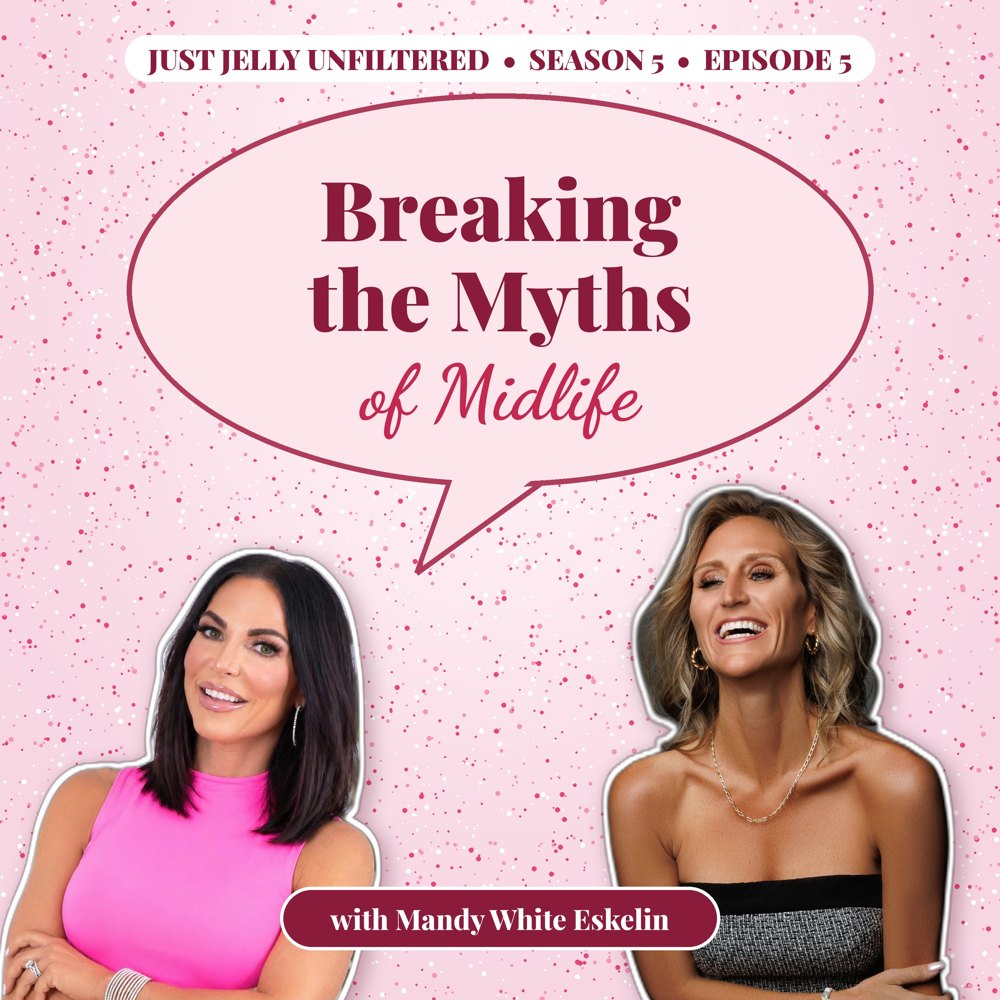
Save this episode to your Pinterest board for the next time you need it.
Before You Go…
💌 Your turn, bestie! Which myth have you believed the longest? Write me back in Pen Pal. I read every note.
🗞️ Want every new episode in your inbox? Sign up for The Sunday Scoop. Every Sunday, I share what I’m loving, what’s new on the podcast and everything happening at Just Jelly.
Thank you for spending part of your day with me. The deeper we dive, the sweeter it gets.
Until our next chat, just stay sweet out there. I love you guys. And whatever you do, don’t quit in the quiet.
Jenn 💋