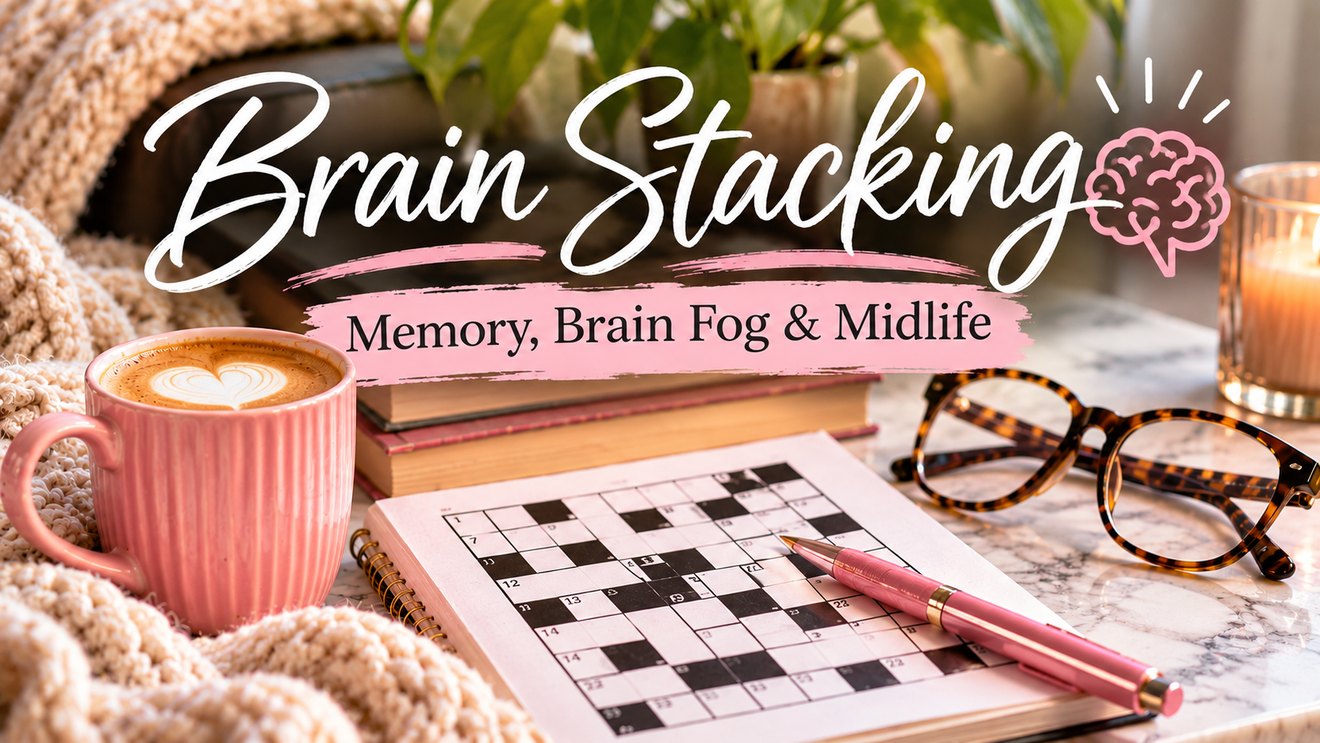
Brain Stacking: Memory, Brain Fog & Midlife
Hey you, it’s me! 💋
Even in midlife, we all have those moments when we feel a little burnt out. Our minds are constantly going, our phones never seem to stop buzzing, and some days we just want to bury the darn things in the backyard and enjoy a little peace and quiet.
But let’s be realistic. We love our phones, too. They’re how we stay connected, catch up with friends, share our lives, and, if you’re anything like me, occasionally lose 30 minutes scrolling without even realizing it.
Well, I came across something trending that caught my attention, and I thought it was interesting enough to share with you. I even shared a video about it on my Instagram Stories. It’s called brain stacking.
Have you heard of it? Because I hadn’t, and naturally, I wanted to learn a little more. I kept coming back to something we’ve all heard: “If you don’t use it, you lose it.” Does that idea apply to our memory, too?
We don’t have to remember phone numbers anymore. Our calendars remind us where to be. GPS tells us where to turn. And when a name is on the tip of our tongue, the answer is one search away. It made me wonder how often I give myself a chance to remember before looking something up.
So grab your coffee, come sit with me for a moment, and let’s talk about brain stacking: what’s trending, what the research actually says, and what it might mean for our minds in the messy middle.
What Is Brain Stacking?
Brain stacking is a social media wellness trend that encourages people to swap some scrolling time for mentally engaging, often offline activities. Think reading a physical book, journaling, doing crosswords or word searches, putting together a puzzle, or learning a hands-on hobby. ABC News highlighted the trend in November 2026.
There’s no established clinical brain-stacking protocol, and the trend itself has not been shown to treat memory problems. But it offers an inviting reason to revisit activities that ask us to pay attention, think, and learn.
What Does the Science Say?
Our brains can adapt through learning and experience, a capacity called neuroplasticity. Research on cognitive training shows that practicing particular skills can improve performance on those skills. Whether those gains carry over broadly to everyday memory or prevent dementia is a much harder question, and the evidence is mixed.
That’s why I’m interested in the activities themselves, rather than promises that a viral routine will “rewire” our brains. Reading, learning a new language, practicing an instrument, and tackling unfamiliar problems all create opportunities to stay mentally engaged.
Are We Remembering Things, or Just Recognizing Them?
Have you ever been trying to remember the name of an actor, and the second someone says it you shout, “YES! That’s it!”? That’s the difference between recall and recognition.
Recognition is noticing that an answer looks familiar when it’s in front of you. Recall means producing it yourself. Both are useful, but they aren’t the same mental task.
Researchers Robert and Elizabeth Bjork describe how familiar material can create a “fluency illusion.” Rereading something may feel easy, even when we couldn’t explain it without looking. They also describe “desirable difficulties,” challenges during learning that can support longer-term retention.
In classic studies by Roediger and Karpicke, students who practiced retrieving learned material often remembered more after a delay than students who simply restudied it. That’s why closing a book and trying to explain what you read can be more powerful for retaining that information than reading the same paragraph again.
Have We Become Too Quick to Look Things Up?
The 2011 “Google effect” research suggested that people sometimes remember where information can be found instead of remembering the information itself. Some highly publicized findings from that work failed to replicate, so we should be cautious about sweeping claims that the internet is ruining our memory.
Cognitive offloading, using tools to hold information for us, can be helpful. I’m not giving up my calendar or GPS. But I do want to experiment with giving myself a few seconds to retrieve a name, a fact, or a detail before I search. That’s a practical suggestion inspired by retrieval research, not a proven treatment for brain fog.
The same caution applies to emerging AI research. A preliminary 2025 MIT study raised questions about how people engage with information while writing with AI assistance, but its early findings do not establish that using AI causes memory loss.
What About Word Searches, Crosswords, and Brain Games?
Different activities ask different things of our minds. Word searches involve visual scanning and recognizing patterns. Crosswords can require us to retrieve words, facts, and associations. Sudoku calls on logic and working memory. Reading asks us to follow ideas and connect new information with what we already know.
Getting faster at one puzzle doesn’t guarantee better memory in every area of life. So mix it up. Try a new kind of puzzle, learn a skill, or read about something unfamiliar. And if you love a word search simply because it helps you unwind, that counts as a perfectly good reason to do one.
Something We Need to Talk About: Midlife Brain Fog
Something we don’t always like talking about, but probably need to, is midlife brain fog. Because your girl over here has been struggling with her memory lately, and I’m talking about more than occasionally walking into a room and forgetting why I went in there.
It’s gotten to the point that I’ve actually talked to my doctor about it. And that’s part of why I’m so passionate about this conversation.
When you notice you’re having a harder time finding words, remembering things, or staying focused, it can make you wonder: Is it stress? Hormones? Poor sleep? Too much on my mind? Or something else worth checking? Those questions sent me down this research rabbit hole.
“We exercise our muscles to keep them strong, so why wouldn’t we give our brains opportunities to stay active, challenged, and engaged?”
Of course, the brain isn’t literally a muscle. Still, the bigger point matters to me. We make plans to move our bodies and protect our strength as we age. Why wouldn’t we make room for curiosity, concentration, and learning, too?
For Women: The Menopause Connection
The Study of Women’s Health Across the Nation (SWAN) has followed women through the menopause transition and measured thinking skills over time. Some analyses found reduced expected improvement on repeated cognitive tests during perimenopause, especially in areas such as verbal learning. That is one way researchers have observed subtle changes during this life stage.
Verbal memory is often part of the conversation: recalling names, words, and information. Many women report feeling foggy during the transition, even though measurable changes are usually modest and do not mean dementia. For many, cognitive performance stabilizes or improves after menopause, although experiences vary.
Sleep deserves its own spotlight. Night sweats, frequent waking, stress, and mood symptoms can all affect how well we concentrate the next day. Studies have also explored links between objectively measured hot flashes and memory performance, but an association does not prove that hot flashes directly cause memory problems.
Hormone therapy is not recommended solely to prevent cognitive decline or treat memory complaints. Decisions about treatment for menopause symptoms belong in an individualized conversation with a qualified healthcare professional.
For Men: Midlife Brain Health Matters, Too
Men experience cognitive concerns in midlife as well. Aging, chronic stress, depression, poor sleep, medications, and health conditions can influence attention and memory. Testosterone generally changes more gradually with age than estrogen does during the menopause transition, and testosterone treatment has not been shown to be a reliable memory fix.
One important issue for men and women alike is obstructive sleep apnea, which can fragment sleep and contribute to daytime fatigue and attention problems. Loud snoring, waking up gasping, or persistent sleepiness are good reasons to seek medical advice.
When Should We Check In With a Doctor?
You know what’s normal for you. When something starts feeling noticeably different, pay attention. If forgetfulness is new, persistent, worsening, upsetting, or interfering with everyday life, bring it up with your healthcare professional. Thyroid disorders, vitamin B12 deficiency, sleep problems, depression, and medication effects are among the possible contributors worth evaluating. Sudden confusion or other abrupt neurological symptoms need urgent assessment.
Brain stacking may be enjoyable and mentally engaging, but it has not been shown to treat menopause-related brain fog, ADHD, or memory disorders. There’s room for both an interesting new hobby and a proper medical conversation.
Let’s Try a Little Brain Stacking
You don’t need an expensive setup or another complicated routine. Here’s one easy 20-minute experiment:
Five minutes: Write a few thoughts in a notebook.
Five minutes: Try a crossword, word search, or Sudoku puzzle.
Five minutes: Read a few pages of something that interests you.
Five minutes: Close the book and see what you can remember, or recall a few items from a list before checking it.
And if one activity has you hooked, stay with it. The five-minute switches are just a way to get started, not a scientifically tested formula.
My Brain Stacking Tool Kit
Because you know I love finding little things that make everyday life more enjoyable, I’m putting together an Amazon Brain Stacking Tool Kit: puzzle books, journals, colorful pens, games, and creative hobbies to help us step away from our screens for a bit.
Shop Mind Over Midlife: Brain Stacking Essentials
What I’m Taking Away
I keep thinking about how quickly we reach for answers. Sometimes I want to give myself a moment to remember, learn, or work something out. Other times, I’ll happily let my phone handle the directions.
I don’t expect a crossword to magically fix brain fog. I do like the idea of staying curious, challenging myself, and making space for something enjoyable. Especially in midlife, when taking care of our health can feel like a full-time job.
Because I plan on using this brain of mine for a whole lot more years, and I’d like to take good care of it along the way.
Now tell me: Have you noticed changes in your memory or concentration? What’s one old-fashioned hobby you’d love to bring back? I’d love to hear what you’re trying in the messy middle.
Until our next chat, just stay sweet out there.
I love you, Jenn
Don’t quit in the quiet.
P.S. Next up in Backstage Conversations: brain games, apps, and hobbies worth trying, followed by a look at morning and nighttime brain dumping.
Quick Answers: Brain Stacking FAQs
What is brain stacking?
A social media trend encouraging people to replace some scrolling with mentally engaging activities, often offline.
Can brain stacking improve memory?
The trend itself has not been clinically validated. Practicing retrieval can improve retention of learned information, but general memory benefits from a mixed hobby routine are not established.
Are word searches good for your brain?
They engage visual attention and pattern recognition. Evidence that they prevent cognitive decline is limited.
Does brain stacking treat menopause brain fog?
No clinical evidence establishes it as a treatment. Persistent or disruptive symptoms deserve medical evaluation.
How long should I do it?
There is no evidence-based brain-stacking dose. Choose a manageable amount of time and activities you enjoy.
Research & Further Reading
Roediger & Karpicke (2006), Test-enhanced learning; overview
Karpicke & Roediger (2008), The critical importance of retrieval for learning
McGill Office for Science and Society, Digital Amnesia Has Been Exaggerated
MIT Media Lab (2025), Your Brain on ChatGPT, preliminary research
Pin This for Later 📌
Save this conversation to your Pinterest board for the next time you reach for your phone.
Tag Me! 🧩
Trying a little brain stacking? Tag me @justjennboard and show me your puzzle, journal or book of the week.
Want more conversations like this? Subscribe to The Sunday Scoop 🗞️, my weekly newsletter filled with midlife conversations, helpful resources, upcoming adventures, and a little bit of everything in between.
As an Amazon Associate, I earn from qualifying purchases. Shopping through these links supports Just Jelly Unfiltered at no extra cost to you.
Write Me Back
Have you noticed changes in your memory or concentration? What’s one old-fashioned hobby you’d love to bring back?